Introduction
Instead of a Preface

How the learning is structured:
- Each level is a self-contained topic that forms a section of the testing discipline. As you work through it, you will get comprehensive theoretical knowledge of the topic from the masters.
- Each theory chapter has a matching theory test and a practical assignment.
- A level ends with a practical assignment. But that is not all the practice: we include additional small assignments and questions throughout every topic.
- All levels are very different: some are mostly theory, others mostly practice. It depends on the topic and the level (toward the end of the course there will be more practice).
- For a level to count as completed, you need to score 60% in both theory and practice. Grades are based on the success percentage of the assignment: 60% and above is satisfactory, 75% and above is good, 90% and above is excellent! Access to the next level opens only after you complete the previous one with 60% or more (95% of students usually pass all assignments within two attempts).
- The course has no report-card grades, but it does have a ratings table. You can track your own rating and compare your progress with other participants. The best students will receive recommendations, prizes, and an invitation to collaborate on a partner's IT project.
- By starting the course you accept and agree to these rules. All course materials are the intellectual property of Galaxy QA Academy and are protected; any copying of the data or imitation of the style is prohibited.
The Advantages of Our Training:
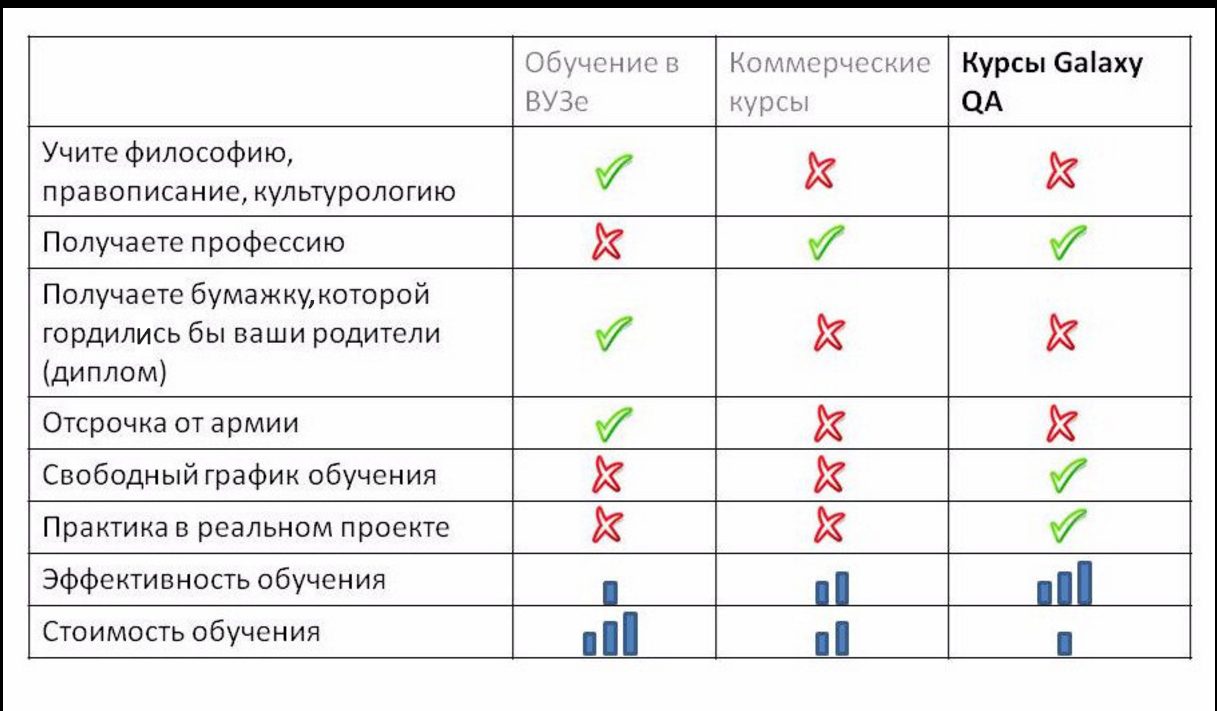
and
*Build a core of the knowledge and skills needed for testing software: desktop, mobile, and web applications;
*Define the goals and objectives of software testing;
*Introduce the basics of software development methodologies: iterative and agile models;
*Outline the main software testing methods;
*Teach how to use and create test documentation: Requirements, Test Plan, Test Case, Bug Report, Test Protocol, and others.
*Teach how to estimate a given task, as well as how to find and document defects;
*Teach the basics of database theory and the use of SQL.
Support for those who have set out on the path of testing:
- Testing is a very specific discipline. That is why all the practical assignments and some of the theory assignments are reviewed personally by a certified specialist. The instructor works for you!
- For every assignment you get feedback, a description of your mistakes, tips, and the chance to retake it if you scored under 60%
- In the quality of its material, our course far surpasses all known alternatives. The project is also unique in the number of practical assignments developed
- The course has its own communities on Facebook and VKontakte. There you can always get support and advice or chat about testing, and after you finish the course, get help finding a job
- After finishing the course, you can get a LinkedIn recommendation from your instructors
- After completing the course you receive a Galaxy QA Academy certificate showing your performance
How Much Will I Earn After the Course?
Tester Salaries According to dou.ua


A Little More About the Course:
- The levels vary in difficulty, and it increases toward the end of the course
- All instructors are practicing testers at top international companies
- We work with HR teams at large IT companies and also build new businesses. Testers who succeed in the course will receive job offers after the exam.
- Wherever necessary, we provide video lessons that explain all the tricky points in detail
- During your studies at Galaxy QA Academy you will build a solid body of knowledge, enough even for a Senior Manual QA level. That doesn't mean you will become a Senior tester right away, but you will have all the knowledge you need to advance your career in this field
Learning Principles:
- Visual clarity. Graphics are remembered far better than plain text and significantly improve how well information is absorbed (by up to 89%, according to research). In addition, the material becomes easier to understand. The text is placed right on the illustrations it refers to
- Conversational style. Recent studies have shown that a personal, conversational style of presenting material (instead of lectures) improved final test results by 40%. We tell you a story instead of giving a lecture. Don't take yourself too seriously. What is more likely to grab a person's attention: a great conversation at the table or a boring lecture?
- Active student participation. Until you start using your brain, nothing will happen in your head. You have to be invested in the result: solve problems, draw your own conclusions, and master new knowledge. That takes exercises and tricky questions that engage both hemispheres of the brain. In addition, every level hides a few “Easter egg” bugs. A tester must be on guard at all times! Submit them in the extra field of the level's final assignment. You will earn bonus points for them, which can be used to raise your grade on any assignment
- Capturing (and holding) the reader's attention. You probably know the feeling: “I really want to learn this, but I fall asleep on the first page.” The brain pays attention to what is interesting, strange, appealing, unexpected. Learning a complex technical subject doesn't have to be boring. Interesting things are learned much faster

(The Force awakens ...
.. the Force needs 5 more minutes)

(Why did episodes 4, 5, 6 come out before 1, 2, 3?
Yoda released, because in charge of planning he was)
- Appealing to emotions. It is well known that our ability to remember depends largely on emotional engagement. We remember what we care about. We remember when we feel something. No, sentimentality has nothing to do with it: we are talking about emotions like surprise, curiosity, interest, and the feeling of “Yeah, I'm awesome!” when you solve a problem that everyone else finds hard and you realize you understand it better than your university professor